


Business leaders yesterday urged the government to heed the call for a legal mechanism to monitor its negotiations with foreign countries so it can end the stalemate over the cross-strait service trade agreement.
The plea came after student-led activists occupied the legislature on Tuesday last week to protest the perceived attempts of Chinese Nationalist Party (KMT) lawmakers to push through the pact without a clause-by-clause review.
“The students should stop their protest after successfully alerting the public to the importance of procedural justice in legislative reviews,” Chinese National Federation of Industries (CNFI) chairman Rock Hsu (許勝雄) told a press conference.
Ruling and opposition lawmakers should seek to iron out their differences in a rational manner to avoid having the legislature in constant paralysis, CNFI and 50 other trade groups said in a joint statement.
Hsu voiced regret that while Taiwan repeatedly slips into political standoffs, trade rival South Korea keeps exporting electronic products, films and TV programs.
The business groups suggested the government bow to public opinion and set up a legislative panel to supervise trade talks with foreign nations.
“We believe an open and transparent policymaking process is the best way to resolve resistance and build social consensus,” the groups said.
By doing so, the government could better facilitate the signing of further pacts with China under the Economic Cooperation Framework Agreement (ECFA), joining talks for the Trans-Pacific Partnership and becoming a member of the Regional Comprehensive Economic Partnership, the statement said.
Chinese National Association of Industry and Commerce vice chairman Nelson Chang (張安平) said it was the government’s duty to make its policies clear and win public support for them, but he and others could not sit around and watch the protests escalate.
While sympathetic to the students’ complaints, Chang threw his support behind the trade pact, saying it would benefit 90 percent of local companies and force the remaining 10 percent to upgrade.
“It makes no sense to give up benefitting the 90 percent because a few may get hurt,” Chang said.
The groups warned against students’ call for nationwide strikes, saying that would exact a heavy toll, causing losses of about NT$120 billion (US$3.92 billion) per day in the manufacturing and service sectors, while foreign buyers could shift orders and ask for compensation if local firms fail to deliver goods on time.
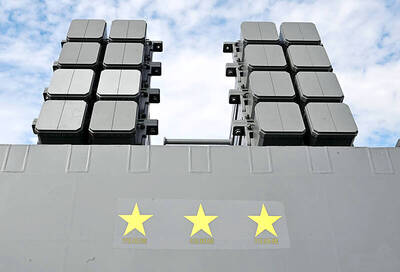
UPGRADE: The Kang Ding-class frigate is replacing its Chaparall missiles with Tien Chien II and Hua Yang VLS, which would provide it with long-range, 360° air defense Taiwan plans to produce 1,200 to 1,376 Hai Chien II missiles (海劍二, Sea Sword II) — also known as TC-2N — to serve as the standard air defense system of the navy’s surface combatant fleet, a source said yesterday. Last week, the Hai Chien II, the naval version of the Tien Kung II missile (天劍二, Sky Sword II), completed a live-fire test in waters off the National Chungshan Institute of Science and Technology’s Jiupeng facility (九鵬) in Pingtung County’s Manjhou Township (滿州). The MIM72 Chaparral and other dated air defense missiles that currently arm Taiwanese ships have inadequate range to combat Chinese

REASONS FOR TRAVEL: An assistant professor said that proposed amendments to penalize drivers if they used drugs overseas would not deter people from traveling People who operate a motor vehicle under the influence of marijuana would have their driver’s license revoked, even if they used the substance while overseas, the Ministry of Transportation and Communications said yesterday, citing proposed amendments to the Road Traffic Management and Penalty Act (道路交通管理處罰條例). The amendments would also authorize the government to revoke the licenses of people determined to have used Category 1 or Category 2 narcotics, even if they were not operating a vehicle while under the influence of drugs, as well as ban them from taking the license test for three years, the ministry said. People aged 18 or

HEAVY WEATHER: Typhoon Jangmi is due to crash straight into the Ryukyus as airlines look to shift flights to larger aircraft or cancel flights to Okinawa entirely Taiwan’s international air carriers announced flight adjustments over the weekend as Typhoon Jangmi is forecast to hit the Ryukyu Islands today and tomorrow. The Central Weather Administration (CWA) upgraded Jangmi from a tropical storm to a typhoon at 8am yesterday, with the eye located 580km south of Naha city. It was moving north at 19kph. Today, China Airlines’ CI-120, CI-121, CI-122 and CI-123 flights between Taoyuan and Naha, Okinawa, have been canceled as well as CI-132 and CI-133 between Kaohsiung and Naha. EVA Air’s BR-112, BR-113, BR-186 and BR-185 flights between Taoyuan and Naha are also canceled. Low-cost carrier Tigerair Taiwan canceled IT-230,
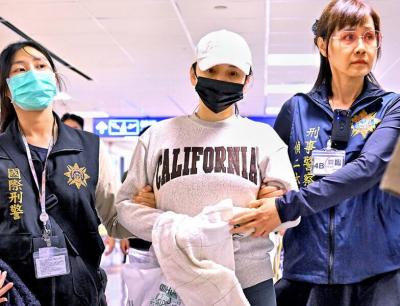
Johanne Liou (劉喬安), a Taiwanese woman who shot to unwanted fame during the Sunflower movement protests in 2014, returned to Taiwan last night after being deported from the US. She is to stand trial in Taiwan for charges involving embezzlement, fraud and drug crimes. The Criminal Investigation Bureau (CIB) said it took her into custody at Taiwan Taoyuan International Airport and would first question her before transferring her to the New Taipei District Prosecutors’ Office. She was arrested upon disembarking a flight from San Francisco that landed shortly before 7pm. Liou absconded to the US in 2019 after jumping bail


 RSS
RSS